Case Study - A SaaS platform delivered without upfront infrastructure spend
Pipelyft is a UK-based start-up developing a data-sovereign sales engagement platform for a global market.
- Client
- Pipelyft
- Year
- Service
- Intelligent Middleware
Overview
Unlike most SaaS products, which store every tenant's data in one place, Pipelyft wanted each customer to run on a separate, fully isolated instance of the application, hosted in a data region of their choice. That gave Pipelyft's clients an easier path to comply with local data legislation.
Pipelyft wanted to do this without spending thousands of pounds upfront on server infrastructure, which meant provisioning each application instance on demand, based on what each customer needed, in a cost-effective way.
We built the pipeline that took Pipelyft from a customer clicking "buy" on their website, through payment on their preferred platform, to a fully provisioned instance running on GitLab pipelines and custom-built Intelligent Middleware, hosted in the cloud region the customer chose.
That gave Pipelyft a deployment and revenue model with no infrastructure risk and a fast path to onboarding new customers.
Working through a similar hosting problem?
The problem
Pipelyft wanted its product to compete on data sovereignty and security, so it took an unusual approach to deployment: every client gets its own separate infrastructure stack, including a physically separate data store, in a geographical region of its choice.
Pipelyft wanted to keep its initial infrastructure overheads at zero and make any costs it did incur scalable, predictable, and tied to revenue as it came in.
That combination, secure, data-sovereign and financially flexible, brought its own technical problems.
- Consistency when provisioning at scale.
Deploying the same application and supporting architecture at the scale Pipelyft needed had to be exact every time, in every location, to avoid support problems and service disruption.
- Ensuring insight and control.
Without a way to see and control every running instance of the Pipelyft application, the team risked an administrative bottleneck that would drain development time as the customer base grew.
- Onboarding new customers.
For the Pipelyft team, the priority was being able to spin up a new instance of the application quickly, reliably and on its own, so new customers had a smooth start.
The build
Deploying the same application and architecture reliably, potentially thousands of times, meant settling on a consistent build method first. We chose a containerised approach using Docker, hosted through amazee.io and Lagoon, their open-source application delivery platform.
DGxC worked with Pipelyft's development team to build a pipeline in their GitLab account that pre-packaged and versioned the whole application, so it could deploy quickly and consistently to Lagoon. Pipelyft's own developers were involved throughout, so they could run and maintain the finished system themselves.
With the application deploying consistently, we turned to managing running instances and automating new ones for each new customer.
For that, we built a piece of Intelligent Middleware responsible for:
- Providing insight.
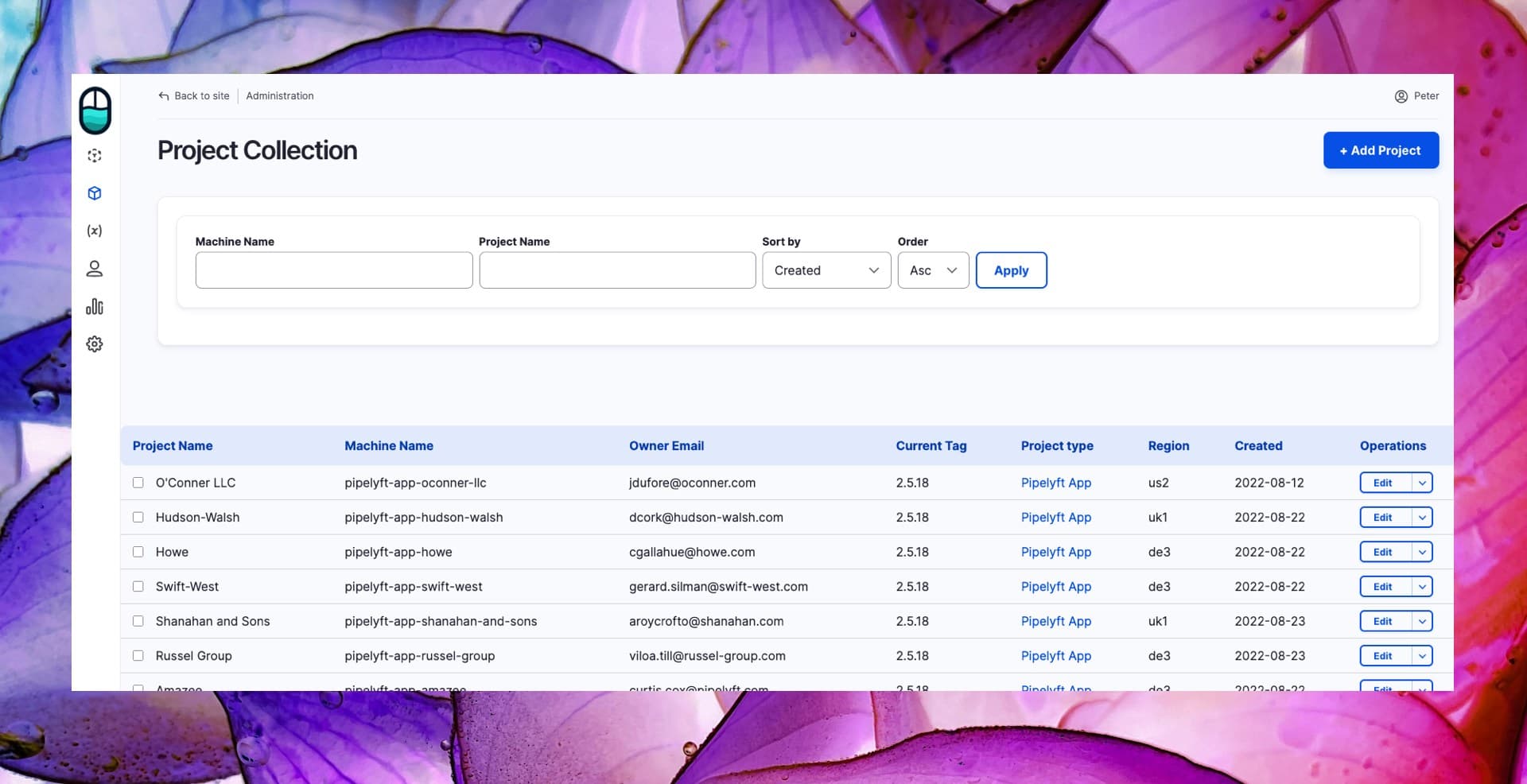
Listing and detailing all live instances of the Pipelyft applications so that they could be easily monitored and modified.
- Smart updates at scale.
Bulk updating live Pipelyft applications on Lagoon to the latest version based on the geo-location of the applications themselves to minimise disruption.
- Application delivery.
Deploying new instances of the application to Lagoon, both manually and autonomously, when a new subscription was purchased via the Stripe payment system.
The resulting Intelligent Middleware application, named "Floodgate" by the Pipelyft team, became the focal point of the system: it orchestrated every moving part for both the Pipelyft team and their clients.
The last piece integrated Stripe into Pipelyft's customer-facing website, so new subscriptions could be accepted directly there.
What Pipelyft ended up with was a hosting and billing pipeline built around how their business runs: a fast, predictable way to onboard new customers without carrying the infrastructure risk themselves.